
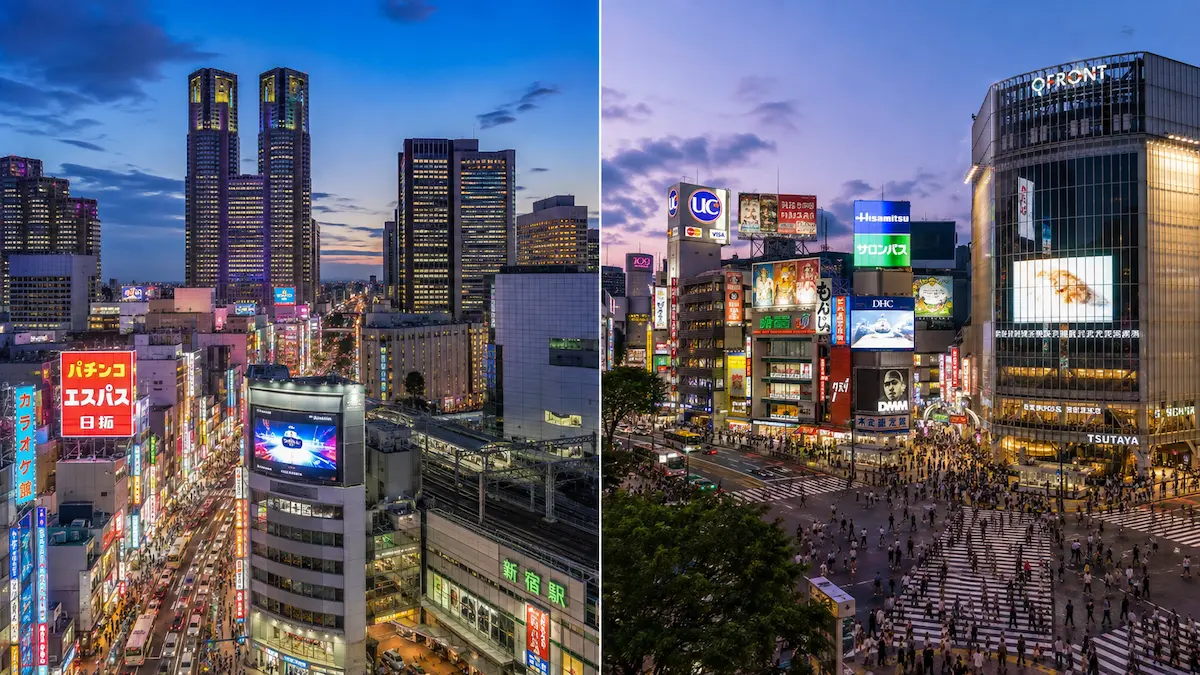
💡 Key Takeaways
- Choose Shinjuku for the easiest all-round first trip: it has a wider hotel range, excellent access to western Tokyo, and convenient departures for many Fuji, Hakone, and regional day trips.
- Choose Shibuya for walkable style and nightlife: it is better placed for Harajuku, Omotesando, Daikanyama, Nakameguro, Shimokitazawa, and travelers who want Tokyo outside the hotel door.
- The biggest trap is booking by neighborhood name alone: a “five-minute walk” can become a sweaty, stair-filled luggage mission if your hotel is on the wrong side of a huge station, uphill, or deep inside a nightlife zone.
Shinjuku vs Shibuya sounds like a simple choice between two famous Tokyo neighborhoods. In reality, the wrong hotel can cost you far more than a slightly higher room rate: extra transfers, long underground walks, confusing exits, steep slopes, late-night noise, and the misery of hauling a suitcase through rush-hour crowds.
Both areas are exciting, well connected, and only a short train ride apart. The real question is not which district looks better on Instagram. It is which one matches your itinerary, budget, luggage, energy level, and tolerance for crowds. This guide gives you the honest version—where each area saves time, where it quietly drains your energy, and exactly which side of each station is worth targeting.
The 1-Minute Cheat Sheet: Shinjuku vs. Shibuya
| What Matters | Shinjuku | Shibuya | Quick Winner |
|---|---|---|---|
| Best for | First-time visitors, families, day-trippers, value hunters, travelers who want maximum hotel choice | Couples, nightlife lovers, fashion and café travelers, repeat visitors, people exploring western and southern Tokyo | Shinjuku for practicality; Shibuya for atmosphere |
| Transport advantage | Huge JR, subway, private railway, and highway-bus hub; especially useful for western Tokyo, Hakone, Mt. Fuji, and Mitaka | Excellent for Harajuku, Omotesando, Shimokitazawa, Daikanyama, Nakameguro, and Yokohama | Depends on your itinerary |
| Typical hotel value | $$ — generally more inventory and more chances to find a sensible mid-range room | $$$ — central rooms often carry a location premium and sell out quickly | Shinjuku |
| Nightlife and street energy | Massive variety, from quiet cocktail bars to Golden Gai and full-on Kabukicho intensity | Younger, trendier, more compact, and easier to combine with shopping, clubs, cafés, and late-night food | Shibuya for a polished night out; Shinjuku for variety |
| Luggage and station stress | More confusing overall; the wrong exit can add a long detour, but the South and New South sides are relatively manageable | More compact above ground, but vertical transfers, construction routes, hills, and crowded crossings can still be painful | Shibuya by a small margin—only with a well-located hotel |
Bottom line: Shinjuku is the safer default recommendation for a first Tokyo stay. Shibuya is the better lifestyle choice when you already know that your trip revolves around fashion, cafés, nightlife, Harajuku, Shimokitazawa, or the city’s southwest side.
Top Survival Tips Before You Book
- Search the exact station exit, not just the neighborhood. A hotel advertised as “near Shinjuku Station” may be convenient for one railway company and awkward for another. Check the hotel’s recommended gate, exit number, elevator route, and walking video before paying.
- Do a luggage-route test on Google Maps. Switch to walking mode, inspect Street View, and look for pedestrian bridges, underpasses, slopes, and crossings. A flat eight-minute walk is often easier than a five-minute route with stairs and crowds.
- For Shinjuku, favor South/New South, West, or Shinjuku-sanchome unless nightlife is the main goal. These areas usually give you a better balance of transport, food, sleep, and less street hassle than staying deep inside Kabukicho.
- For Shibuya, station-connected hotels are worth paying extra for when you have large luggage. Mark City, Shibuya Stream, Sakura Stage, and other connected or near-connected developments can save a surprising amount of energy.
- Do not move large suitcases during weekday rush hour. Even an easy route becomes unpleasant when platforms and concourses are packed. Use luggage forwarding, airport delivery, hotel storage, or travel outside commuter peaks.
- Check room size, not just star rating. A stylish central Tokyo hotel can still have barely enough floor space to open two suitcases. For couples, compare square meters and bed width before comparing lobby photos.
- Be honest about where you will spend your days. If most of your itinerary is Asakusa, Ueno, Tokyo Station, Ginza, and Tokyo Disney Resort, neither Shinjuku nor Shibuya is automatically the smartest base. Staying farther east may save more time.
- Never follow street touts into bars or clubs. Tokyo is generally easy to navigate, but police specifically warn visitors about touts and rip-offs in entertainment districts. Choose venues yourself and confirm cover charges before ordering.
The Full Experience
📍 Shinjuku: Best Overall for First-Time Visitors, Day Trips, and Hotel Choice
Feature tags: 🚆 Mega Transport Hub · 💰 Better Hotel Value · 🗻 Best for Western Day Trips · 🍜 Huge Food Choice · ⚠️ Station Maze
Shinjuku is the practical winner for most first-time visitors—not because it is calmer or prettier, but because it gives you options. You can sleep in a quiet business district, walk to department stores and thousands of restaurants, catch trains across Tokyo, and leave for popular excursions without crossing the city first.
The area is also much bigger and more varied than many travelers expect. “Staying in Shinjuku” could mean a peaceful tower hotel in Nishi-Shinjuku, a convenient room near the South Exit, a shopping-focused stay around Shinjuku-sanchome, or a neon-heavy hotel in Kabukicho. Those experiences are not interchangeable.
Why Shinjuku Works So Well
Shinjuku connects JR lines, the Tokyo Metro Marunouchi Line, Toei subway lines, the Keio and Odakyu networks, and major bus services. That makes it especially useful for travelers planning Ghibli Museum or Kichijoji, Hakone, Lake Kawaguchiko and Fuji-area trips, or neighborhoods west of central Tokyo.
It is also forgiving when hotel prices spike. Shinjuku generally has more rooms across more price levels than central Shibuya. When one block is expensive, you can often shift toward Nishi-Shinjuku, Okubo, Higashi-Shinjuku, or Shinjuku-sanchome without abandoning the wider area.
Best Parts of Shinjuku to Stay
- South Exit and New South Exit: The best all-round choice for first-timers with luggage. You are close to JR platforms, the express bus terminal, department stores, Yoyogi, and a less chaotic evening atmosphere. Hotels can be expensive, but the convenience is real rather than marketing fluff.
- West Shinjuku and Nishi-Shinjuku: Best for families, business travelers, light sleepers, and travelers who prefer wider streets. The trade-off is a longer walk to the livelier east side and, for some hotels, an extra subway stop or 10–20 minutes on foot.
- Shinjuku-sanchome: The underrated compromise. You get excellent shopping, dining, access to Shinjuku Gyoen, the Marunouchi and Fukutoshin lines, and a more manageable walk than many hotels north of Kabukicho.
- East Shinjuku and Kabukicho: Best for late-night food, bars, entertainment, and travelers who actively want neon outside the door. Rooms can be good value, but noise, crowds, adult businesses, touts, and an awkward walk from some JR platforms are genuine downsides.
- Okubo and Shin-Okubo: Great for Korean food, casual dining, and lower prices. It can feel crowded and less polished, and it is not the same as being next to Shinjuku’s main station complex.
Where Shinjuku Saves You Time
Shinjuku is strongest when your itinerary includes western Tokyo or trips leaving from its bus and private-rail terminals. It is convenient for Nakano, Koenji, Kichijoji, Mitaka, and many Fuji or Hakone routes. The Marunouchi Line also gives a straightforward ride toward Tokyo Station and Ginza, while the JR network covers major hubs around the city.
Late at night, Shinjuku’s huge food and convenience-store supply is another practical advantage. You are less likely to return from a long day and discover that your immediate area has shut down.
✅ What Other Travelers Say
Traveler discussions repeatedly praise Shinjuku for its range of hotels, late-night food, and ability to reach many parts of Tokyo without overplanning. Budget-conscious visitors often find more workable rooms here than in Shibuya, and day-trippers appreciate starting close to bus and train departure points.
The repeated complaint is equally consistent: the station can make a nearby hotel feel far away. Visitors who arrive tired, choose the wrong exit, or rely only on the hotel’s straight-line distance often spend their first evening circling underground passages with luggage.
⚠️ The Catch (Things to Keep in Mind)
The station is not one simple building. Different railways, gates, underground malls, and exits connect across a huge area. Save the hotel’s recommended exit as a screenshot, and use the official station map rather than assuming every “Shinjuku” sign leads to the same place.
Kabukicho requires normal nightlife caution. It is not accurate to describe all of Shinjuku as dangerous, and many travelers stay there without problems. However, Tokyo police warn that foreign visitors are being targeted by street touts and bar rip-offs. Do not follow anyone who approaches you with a special drink deal, club invitation, or “local recommendation.”
Some west-side hotels are farther from the action than they look. The skyscraper district is comfortable, but walking to Golden Gai, Isetan, or the east-side restaurant streets every day adds mileage. Check which side of Shinjuku matches your actual evenings.
Choose Shinjuku if: this is your first Tokyo trip, you are staying four or more nights, you want hotel choice, you plan day trips west of Tokyo, or your group has mixed interests and needs a flexible base.
Skip Shinjuku if: you hate giant stations, your itinerary is concentrated in eastern Tokyo, or you want a compact neighborhood where the best cafés, boutiques, and nightlife are naturally linked by walking.
📍 Shibuya: Best for Nightlife, Fashion, Walkability, and Tokyo Energy
Feature tags: 👟 Walkable West Tokyo · 🛍️ Fashion and Shopping · 🍸 Stylish Nightlife · 💑 Great for Couples · 💸 Higher Room Premium
Shibuya is the more emotionally satisfying place to stay when you want to feel Tokyo immediately. Step outside and you are already among major shops, cafés, music venues, bars, restaurants, and the city’s most recognizable crossing. Harajuku, Cat Street, Omotesando, and Yoyogi Park can be combined into long walking days without constant train hopping.
It also gives you better access to the southwest side of the city. The Keio Inokashira Line runs toward Shimokitazawa and Kichijoji, the Tokyu Toyoko Line heads toward Daikanyama, Nakameguro, and Yokohama, and the Hanzomon and Fukutoshin subway lines connect useful shopping and sightseeing areas.
Why Shibuya Feels Easier
Shibuya is still a complicated station, but the neighborhood’s attractions form a more natural walking circuit than Shinjuku’s widely separated east, west, north, and south zones. A traveler focused on shopping, food, photography, and nightlife can spend an entire day around Shibuya without feeling trapped in one commercial complex.
For couples and younger travelers, Shibuya often feels more cohesive after dark. Dinner, cocktails, record shops, fashion, live music, and a late walk back to the hotel can all happen within one district.
Best Parts of Shibuya to Stay
- Station-connected and Mark City side: The least painful option for luggage and airport-bus access. Hotels here are rarely cheap, but you are paying for genuinely useful connectivity, not just a famous postcode.
- Miyashita Park and Meiji-dori side: Best for walking to Cat Street, Harajuku, and Omotesando. The area is fashionable and lively, though traffic and nightlife noise vary by building.
- Shibuya Stream and Sakura Stage side: A good choice for newer hotels, restaurants, and a slightly calmer atmosphere. Pedestrian routes can feel indirect while redevelopment continues, so check the latest hotel access instructions.
- Dogenzaka: Best for clubs, bars, late-night food, and travelers who want the busiest part of Shibuya. It is uphill, crowded, and mixed with love hotels and adult nightlife. This is not the ideal choice for everyone carrying children or oversized luggage.
- Shinsen: Quieter and more local, with good restaurants and access to the Inokashira Line. The downside is that walking back from central Shibuya often involves a slope.
Where Shibuya Saves You Time
Shibuya is ideal when your plans include Harajuku, Omotesando, Aoyama, Daikanyama, Nakameguro, Shimokitazawa, Ebisu, or Yokohama. You can reach many of these places directly or combine them on foot, reducing short train rides and repetitive station transfers.
The Ginza Line is also useful for direct trips toward Ginza and Asakusa, while JR services cover Shinjuku, Shinagawa, Ikebukuro, and other central hubs. Narita Express trains serve Shibuya as well as Shinjuku, although travelers should always check the current timetable rather than assume every departure stops at both.
✅ What Other Travelers Say
Travelers who love Shibuya usually mention the same things: they can walk to Harajuku and Omotesando, return easily after drinks, and feel surrounded by the version of Tokyo they came to experience. Repeat visitors often prefer it because the Toyoko and Inokashira lines open up neighborhoods beyond the standard first-trip circuit.
The main criticism is value. Shibuya has fewer obvious mid-range bargains near the station, and the cheapest room may still be smaller, noisier, or farther uphill than a similarly priced Shinjuku option. Travelers also report that “close to Shibuya Station” can be misleading when the route involves multiple levels or a long walk around construction.
⚠️ The Catch (Things to Keep in Mind)
Shibuya is still under long-term redevelopment. Entrances, pedestrian decks, and recommended walking routes can change. Read recent hotel access reviews, especially when arriving with luggage or a stroller.
The station is vertical. Transfers between JR, subway, Tokyu, and Keio services may involve several levels. A connection that looks short on a map can include elevators, escalators, and crowded corridors.
The hills are real. Dogenzaka, Shinsen, and parts of Sakuragaoka can turn a short walk into a workout. This matters more after 20,000 steps, in summer humidity, or with wheeled luggage.
Shibuya is not automatically quieter or safer than Shinjuku. It has busy nightlife areas too. The atmosphere is often less intense than Kabukicho, but drink-spiking, overcharging, and tout-related risks are reasons to choose established venues and keep control of your drink and card.
Choose Shibuya if: you prioritize fashion, nightlife, cafés, live music, Harajuku, Shimokitazawa, or southwest Tokyo; you are traveling as a couple; or you are happy to pay more for a compact, high-energy location.
Skip Shibuya if: you need the broadest hotel inventory, you have several early Fuji or Hakone departures, you are traveling with multiple large suitcases, or you want a quiet room without paying a premium for it.
Which Area Wins for Your Travel Style?
| Traveler Type | Best Choice | Why |
|---|---|---|
| First-time visitor | Shinjuku | More hotel choice, broad transport coverage, and easier access to popular day trips |
| Couple on a food and nightlife trip | Shibuya | More compact evenings and easy walking between dinner, bars, shopping, and the hotel |
| Family with children | Shinjuku South or West | Better room selection, calmer streets, airport and highway-bus convenience; avoid deep Kabukicho |
| Solo traveler who wants late nights | Either | Shinjuku has more variety; Shibuya feels more compact and trend-focused |
| Fashion, vintage, cafés, and photography | Shibuya | Walkable to Harajuku, Omotesando, Cat Street, and direct access to Shimokitazawa and Nakameguro |
| Mt. Fuji, Hakone, or western Tokyo day trips | Shinjuku | More convenient rail and bus departure options |
| Large luggage or limited mobility | Hotel-specific decision | A station-connected Shibuya hotel may beat a remote Shinjuku hotel; South Shinjuku can beat uphill Shibuya |
| Budget-conscious traveler | Shinjuku | Usually a wider range of business hotels and more alternatives within the broader district |
Key FAQs
Is Shinjuku or Shibuya better for first-time visitors to Tokyo?
Shinjuku is better for most first-time visitors because it offers more hotel options and works well for a mixed sightseeing itinerary. Stay near the South/New South Exit, West Shinjuku, or Shinjuku-sanchome to reduce station stress. Choose Shibuya instead when Harajuku, Omotesando, nightlife, and western Tokyo neighborhoods are the main focus of your trip.
Is Shinjuku or Shibuya better for families and safety?
Neither entire district should be labeled unsafe, but the micro-location matters. Families usually find South or West Shinjuku easier than Kabukicho, while the quieter Stream, Sakura Stage, or Shinsen sides of Shibuya can work well if the walking route is manageable. In both areas, avoid following street touts, confirm bar charges, and choose a hotel away from club streets when sleep matters.
Which is easier from Narita or Haneda Airport with luggage: Shinjuku or Shibuya?
Both Shinjuku and Shibuya are served by selected Narita Express trains, so the better choice depends on your hotel’s distance from the relevant platform and the timetable on your travel day. From Haneda, train routes usually require a connection, while airport buses may serve selected hotels or terminals. With heavy luggage, a station-connected hotel or luggage-delivery service matters more than the neighborhood name.
Final Verdict and Your Next Step
Book Shinjuku when you want the most dependable all-round base, better odds of finding a room at a sensible price, easy access to western Tokyo, and convenient day-trip departures. For the least stressful stay, search South/New South Exit, Nishi-Shinjuku, or Shinjuku-sanchome before looking at deep Kabukicho bargains.
Book Shibuya when your ideal Tokyo trip is built around fashion, cafés, nightlife, Harajuku, Omotesando, Shimokitazawa, Daikanyama, and returning to a lively neighborhood every evening. Pay close attention to slopes, station levels, and whether the hotel is genuinely connected to your most-used line.
My practical verdict: Shinjuku wins for the average first trip. Shibuya wins for a more focused, style-led trip. A good hotel on the correct side of either station will beat a cheaper hotel that forces you into a 15-minute luggage walk every arrival and departure day.
Tokyo’s best-located rooms are often the first to disappear, especially during cherry-blossom season, autumn foliage, school holidays, concerts, and long weekends. Reserve a refundable rate early, then recheck prices rather than waiting until only awkward locations remain.